

You have probably heard the term "annual well-woman visit" before. Or maybe it was called your annual exam, gynecological exam, or women's wellness visit. It might have come up in a reminder email from your doctor's office or in a conversation with a friend who said something like, "I've heard about the speculum, but what actually happens during the visit?" If you have ever wondered what to expect, you are not alone. Understanding what happens during each part of the appointment and what types of exams may come at different ages in your life can help you feel more comfortable, prepared, and confident walking through the door.
This visit is different from your yearly physical, but both work together to support your overall health. And if you want to get the most out of your appointment, a little preparation goes a long way. Coming in ready helps you feel informed, empowered, and ready to advocate for yourself.
A quick note on language: We use the term "well-woman visit" because it is the name most people recognize and the term most insurance plans use. If you have a vulva, breasts, or a uterus, these visits are an important part of your healthcare, regardless of your gender identity.
This post is for general information only and is not medical advice. For guidance about your specific health, talk with your healthcare provider.
A well-woman visit is a yearly appointment focused on your reproductive and sexual health, though it often covers more than that. It is a chance to talk about your menstrual cycle, birth control, fertility, sexual health, menopause, and your emotional well-being and to complete recommended screenings like cervical cancer testing.
It is different from a yearly physical, which focuses on your overall health (blood pressure, cholesterol, heart and lung health, vaccinations, and screening for conditions like diabetes). The two work together rather than replacing each other. Well-woman visits are commonly provided by an OB/GYN or a Women's Health Nurse Practitioner, though some primary care clinicians offer them too.
Just as important, these visits let you build a relationship with a provider you trust, which makes it easier to ask personal questions and get care over time.
Source: American College of Obstetricians and Gynecologists, Healthy Living.
There is nothing complicated to do beforehand. The most helpful thing is to arrive ready to have a conversation. Before your visit, it can help to:

Many people remember their questions only after they have left, so keeping a list on your phone or on paper really helps. And cost should never stand between you and your care: A Step Ahead Chattanooga covers the cost of a yearly well-woman visit with our partner clinics. If birth control costs are a barrier, we can help with that too (more below).
Download our Healthcare Advocacy Handout
Every visit is a little different depending on your age, health history, symptoms, and needs. Most include many of the following.
A conversation about your health. Your provider will usually start by getting to know your health or, if you have been before, asking what has changed since your last visit. Expect questions about your last period, medications, allergies, past surgeries, sexual activity, pregnancy history or plans, your mental and emotional well-being, and whether you feel safe at home. This is your chance to raise anything on your mind. No question is too small. If it's your first visit, this conversation may be most of the appointment, and that's completely normal.
Vital signs and a general health check. Usually your height, weight, and blood pressure, and sometimes a listen to your heart and lungs or other basic checks.
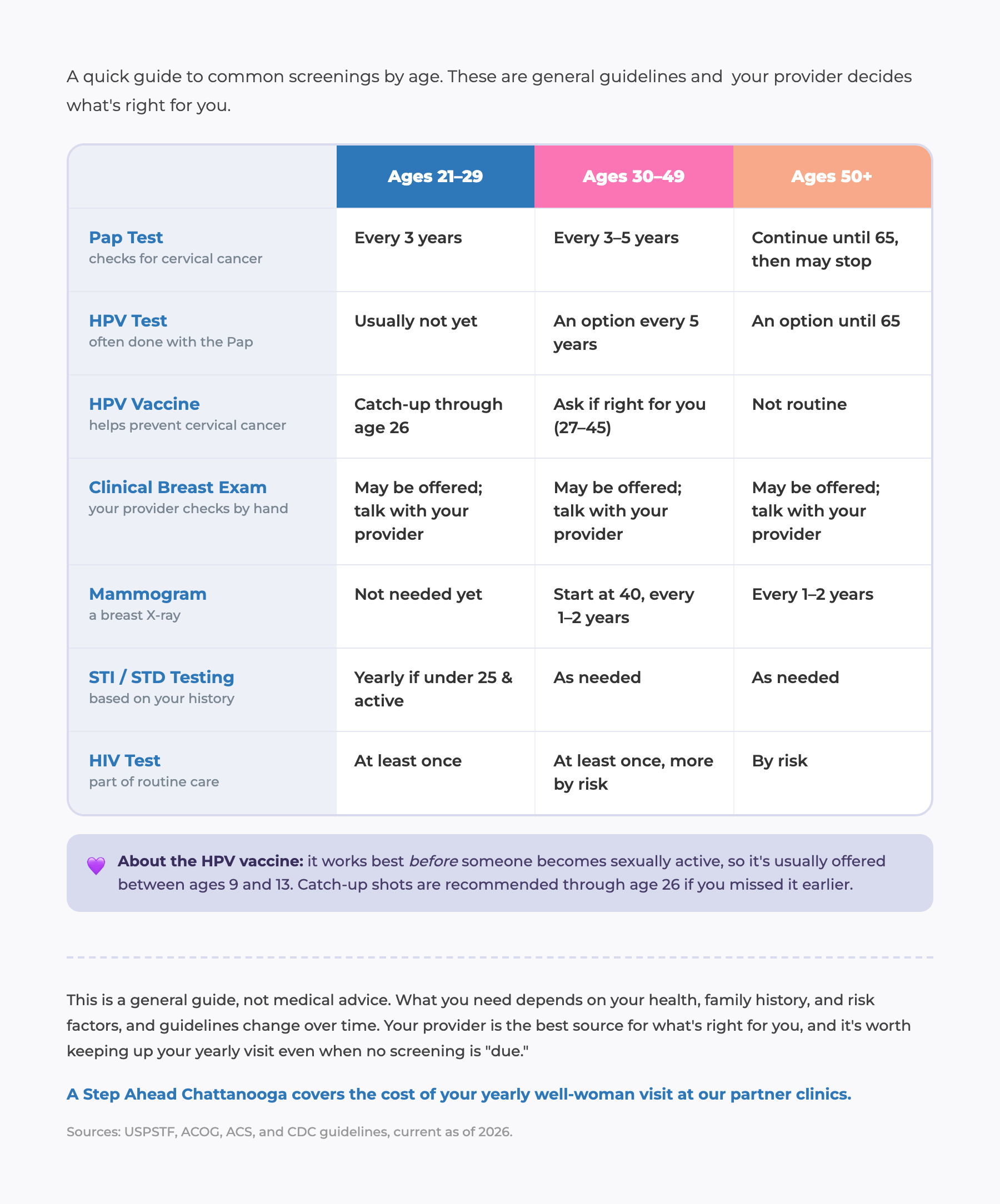
Clinical breast exam. ACOG says a clinical breast exam may be offered every one to three years for women aged 25 to 39 and yearly for women 40 and older. Whether it is part of your care is something you and your provider decide together. During it, they gently check your breasts and the surrounding area, including under your arms, for changes such as lumps or swelling. If you notice a new lump, skin changes, nipple discharge, persistent pain, or anything different, tell your provider even if it is not time for a scheduled visit.
Pelvic exam. Some visits include one, some do not. Whether you need one, and which parts it includes, depends on your age, symptoms, history, and reason for the visit. A pelvic exam can have a few parts:
Your provider should explain what they are doing and why. It may be slightly uncomfortable but should not be painful. You can ask questions, ask for a pause, or say how you are feeling at any point.
Source: American College of Obstetricians and Gynecologists, Well-Woman Visit.
Cervical cancer screening. This is not part of every visit; your provider may recommend it based on your age, history, and previous results. For many people ages 21 to 29, screening is usually a Pap test. Between 30 and 65, it may include an HPV test, a Pap test, or both. When it is done, it happens during the speculum step above: Your provider collects a small sample of cells from your cervix with a soft brush or small spatula, which goes into a liquid and is sent to a lab to check for abnormal cells (the Pap test), high-risk HPV, or both. Often one sample covers both tests. Because recommendations change over time, your provider can help you choose the right approach and schedule for you.
The chart below is an at-a-glance look at what tends to happen when, from your 20s onward. It reflects general guidance for people at average risk, so your own schedule may differ based on your health history and risk factors. Your provider can help you figure out what applies to you.
The chart starts in the 20s, but there is no single right age to begin. Some people start sooner depending on their body, their symptoms, or their needs. If something feels off or you have questions, it is always okay to see a provider, whatever your age.
Source: American College of Obstetricians and Gynecologists, Updated Cervical Cancer Screening Guidelines.
Not every screening or vaccine is automatic. What you need depends on your age, health history, and personal situation, so these are good things to raise with your provider.
STI testing, for example, is not done at every visit. Whether it is recommended depends on your age, sexual history, symptoms, and preferences. If you would like STI testing or have questions about your sexual health, just tell your provider.
An HIV test is recommended at least once for just about everyone as part of routine care, and more often if you have ongoing risk factors. If you are not sure whether you have ever been tested, your visit is a good time to ask.
The HPV vaccine helps protect against the types of HPV most likely to cause cervical and other cancers. It works best before someone is exposed, which is why it is routinely recommended at ages 11 to 12 and can start as early as 9. Catch-up vaccination is recommended through age 26 for anyone not fully vaccinated (a two- to three-shot series). Some adults ages 27 to 45 may still benefit and can decide with their provider. If you are unsure whether you are up to date, your visit is a good time to ask.
If there is any screening or vaccine you are wondering about, it is always okay to ask.
Source: American College of Obstetricians and Gynecologists, HPV Vaccination FAQ.
Source: American College of Obstetricians and Gynecologists, Routine Human Immunodeficiency Virus Screening.
Your visit is a great time to talk about birth control, whether you are happy with your method, thinking about switching, or considering it for the first time. You do not have to wait for your provider to bring it up. Beforehand, think about what you like and dislike about your current method, your goals (preventing pregnancy, spacing pregnancies, managing symptoms), and any side effects or concerns. There is no single best method; the right one is the one that works for you. If you use an IUD, this is also a good time to confirm it is still in place.
If cost or access has been a barrier, A Step Ahead Chattanooga provides free birth control across our 18-county service area through our clinical partners, regardless of insurance status.
Get Free Birth Control Compare MethodsYou do not have to wait for your next appointment if something does not feel right. Reach out if you notice irregular periods or unusual bleeding, pelvic pain, pain or difficulty urinating, breast changes, or any new or concerning symptoms that develop suddenly.
Preparing does not have to be complicated: a few notes about your health, a list of questions, and the confidence to speak up can turn a routine visit into a meaningful conversation. And cost should not be one of your worries. If you live or go to school in our 18-county service area, A Step Ahead Chattanooga covers the cost of your annual well-woman visit at our partner clinics, so you can focus on your health instead of the bill.
For more tips on speaking up during appointments, download our Healthcare Advocacy Handout. And remember, while this guide can help you prepare, your provider is the best source of advice for your individual health.
Still have questions? Visit our FAQ page.