
STIs are incredibly common — 1 in 2 sexually active people will contract one by age 25. Stigma stops people from getting tested and treated, which allows infections to spread. The fix? Accurate information, regular testing, open conversations, and ditching the shame. You're not "dirty" for getting an STI. You're human.
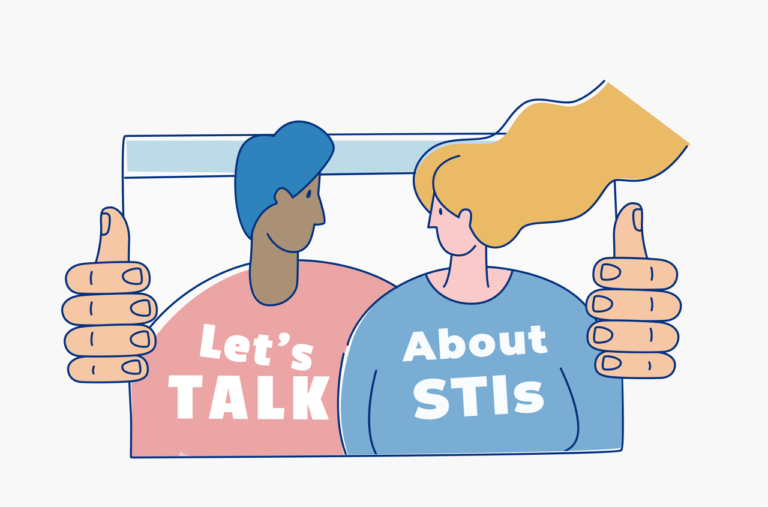
Let's talk about it.
STIs, sexually transmitted infections, are incredibly common. According to the CDC, 1 in 2 sexually active people will contract an STI by age 25. It's likely that someone you know has had one. It's also likely that they didn't talk about it, didn't know what to do, or didn't seek care because of fear, shame, or misinformation.
This kind of stigma can be harmful, and we want to help break that cycle.
At A Step Ahead Chattanooga, we believe everyone deserves access to accurate, shame-free information. We care deeply about helping our community feel empowered and supported when it comes to sexual health. That includes normalizing conversations about STIs and encouraging regular testing, treatment, and prevention.
STI stands for sexually transmitted infection, and it refers to any infection that's primarily passed through sexual contact. There are more than 20 different types of STIs — some are caused by bacteria (like chlamydia or gonorrhea), some by viruses (like HPV or herpes), and some by parasites (like trichomoniasis).
In recent years, "STI" has become the preferred term because it's more accurate. "Infection" means the presence of a virus, bacteria, or parasite in the body — sometimes without any symptoms. "Disease" implies visible signs or symptoms, which many people with STIs never have. So while all STDs are technically STIs, not all STIs become diseases. Using "STI" helps reduce stigma and better reflects the medical reality.
Many STIs have no symptoms at all, which is why regular testing is so important — even if you feel completely fine.
STIs can be passed from one person to another through a variety of ways, including:
Some STIs, like HIV or hepatitis B, can also be transmitted through non-sexual contact, like sharing needles or from parent to baby during childbirth.
You can contract an STI even if you've only had sex once, even if you're in a committed relationship, and even if your partner has no symptoms.
STIs are often associated with judgment — people hear "STI" and think "bad," "irresponsible," or "dirty." Let's bust those myths right now.
Myth STIs are a punishment for irresponsible behavior.
Truth You can get an STI the very first time you have sex. STIs are infections, not moral failures.
Myth If you used protection, you can't get an STI.
Truth Condoms significantly reduce risk but don't eliminate it entirely — especially for skin-to-skin infections like herpes or HPV.
Myth People in committed relationships don't get STIs.
Truth Many STIs can remain undetected for years. Someone can have an infection without knowing it and pass it on in a monogamous relationship.
Myth Having an STI makes you "dirty."
Truth Having an STI makes you human. The shame and silence around STIs is what allows untreated infections to spread — and that's something we can change.
We all have a part to play in smashing the stigma around STIs. Here are a few ways to start:
STI testing methods vary depending on the type of infection and are all generally painless. Some STIs, such as chlamydia and gonorrhea, can be detected through a simple urine test. Other STIs, such as HIV and syphilis, require a blood test. Your provider will take a swab of a genital sore to test for herpes.

There are several places you can go for STI testing.
If you live or go to school in our 18-county service area and are requesting free birth control through A Step Ahead Chattanooga, you can ask for STI testing during your birth control appointment. Just talk to the healthcare provider when you go in for your visit.
To schedule an appointment, give us a call at 423-265-7837.
If you're simply looking for a nearby clinic that offers STI testing, this tool from the CDC is a great place to start: GetTested.CDC.gov
While A Step Ahead Chattanooga focuses on removing barriers to contraception, we encourage individuals seeking STI education and services to consult the resources below.
CDC STI Resources — Extensive information on STI prevention, testing, and treatment.
STI Testing Resources — Conversation tips on how to talk to your partner(s) about testing.
ASHA Resources — Educational materials and tools to reduce STI stigma.
TDH STD Program — Information on STI prevention and care activities in Tennessee.
End the Syndemic TN — A hub for harm reduction resources across the state.
CEMPA Services — Offers testing and education in Hamilton County and surrounding areas.
If you live or go to school in our 18-county service area and are 18+, we'll mail you free condoms at no cost to you.
Request Free Condoms