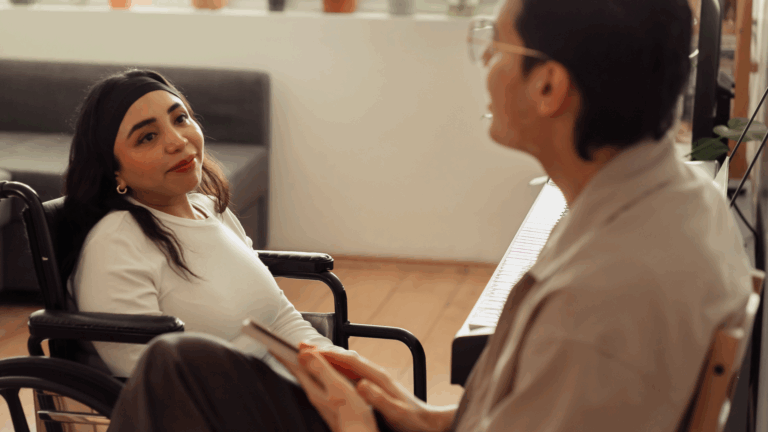
July is Disability Pride Month, a time to honor the diversity, strength, and contributions of people with disabilities while raising awareness about the barriers they still face. At A Step Ahead Chattanooga, we’re using this moment to spotlight an issue often overlooked: access to reproductive healthcare.
People with disabilities encounter persistent barriers and inequities in reproductive healthcare. For much of modern history, they were excluded from making decisions about their reproductive health. In some cases, this even included forced sterilization, a practice that was common well into the 20th century and, in some instances, continues today through legal systems like guardianship laws.
Center for American Progress, 2023
Assuming people with disabilities can’t make their own choices leads to harmful care. Respecting their autonomy leads to better health and stronger communities.
AnsIRH, 2023
New research continues to show the real barriers people with disabilities face when trying to access reproductive healthcare, even when services exist. A 2025 study published in JAMA Network Open found that women with disabilities are 32% less likely to use any form of birth control than nondisabled women, largely due to cost (Contreras, 2025).
While programs like Medicaid and TRICARE fully cover FDA-approved birth control methods, Medicare does not. For the 1.5 million reproductive-aged women with disabilities who rely on Medicare, many methods, including permanent options, are not fully covered. Some are excluded entirely.
The research found that women who gained dual enrollment in both Medicare and Medicaid experienced a 35% increase in birth control use, demonstrating the significant impact of removing cost barriers on access (Contreras, 2025).
But insurance is only one piece of the puzzle. Many women with disabilities also:
This reinforces why accessible, respectful, and affordable care isn’t optional; it’s essential.
At A Step Ahead Chattanooga, we’re working to make reproductive healthcare more inclusive for people with disabilities. This includes both internal learning and external action:
Engaging in a multi-part team training on neurodiversity and auditing our website, core communications, and educational programming to improve inclusivity
Participating in national conversations around disability inclusion, including virtual sessions and in-person training at the National Reproductive Health Conference
Earning certification in a sex education curriculum designed for people with intellectual and developmental disabilities (I/DD)
Adding a Telehealth partner in 2023 to improve virtual access to care, and in 2024, 6% of our Telehealth clients identified as having a disability compared to 3% at physical clinics, showing it’s helping fill a critical access gap
Talking with our partner clinics and Telehealth providers about reducing barriers and increasing accessibility
Supporting policies that expand reproductive healthcare access for people with disabilities
You can help make a change by:
Asking clinics about ADA compliance
Requesting telehealth tools with accessibility features like captions or screen reader access (our Telehealth partner, Twentyeight Health, includes an accessibility panel on their website that lets users customize display and functionality to meet individual needs)
Learning about supported decision-making and legal rights under guardianship
Connecting with local disability justice groups
People with disabilities deserve the same respect, options, and autonomy in reproductive healthcare as anyone else. When we remove barriers and design systems that include everyone, we move closer to a future where reproductive healthcare truly serves all.
If you or someone you know is looking for free, accessible birth control, including IUDs, implants, or birth control pills, A Step Ahead Chattanooga is here for you. We cover the full cost of care related to your birth control appointment(s) with our partnered clinics. No insurance or income requirements, just support, respect, and options. Call or text us at (423) 265-7837 or visit astepaheadchattanooga.org to get started.
We collect cookies to analyze our website traffic and performance; we never share any personal data. View our Privacy Policy.